Parameters and Results
Top-level parameters
Wrappers reject keyword arguments not declared by the tool. input_paths accepts one string, a list, a tuple, or None; one string is normalized to a one-item list. Other values must be convertible to JSON primitives, lists, or dictionaries.
Parameters objects
Tools with nested Parameters normally provide a _parameters() factory:
params = mls.point_cloud.pointcloud_extract_by_elevation_parameters()
params.minElevation = 10
params.maxElevation = 80
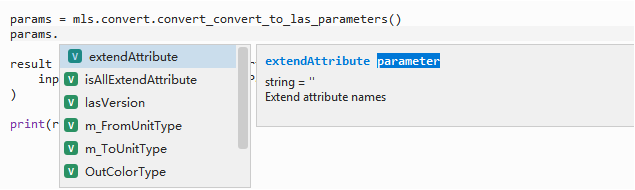
Parameter object and field completion
ParameterObject behaves like a dictionary and supports attribute access for safe field names, to_dict(), __fields__, and __field_docs__. Unknown top-level arguments or nested fields are rejected before the application tool runs.
ToolResult
| Member | Meaning |
|---|---|
ok |
Whether the call succeeded |
tool_id |
Actual tool identifier |
result |
Tool result object or wrapped raw response |
data |
Result data dictionary, or an empty dictionary |
message |
Extracted user message |
error_code |
Four-digit, root-cause-first user error code |
outputs |
Normalized output list |
output |
First output, or None |
raw |
Complete unabstracted response |
require_ok() |
Raises ToolExecutionError on failure |
Failure handling
The default is raise_on_error=True, which raises ToolExecutionError for a failed tool. Catch it, or use raise_on_error=False and inspect the result:
result = mls.project.get_project_info(raise_on_error=False)
if not result.ok:
    print(result.error_code, result.message)
When the response shape is unclear, inspect result.result, result.data, and result.raw. Not every tool creates files, so result.output may be empty.