Point Cloud to DEM
Note: If the point cloud has already been classified, you can generate the DEM using only the ground-class points.
Steps
- Click the Point Cloud to DEM
 button.
 - The Point Cloud to DEM dialog box appears. Select the input point cloud and source classes, then configure the tiling method and related parameters according to the output requirements.
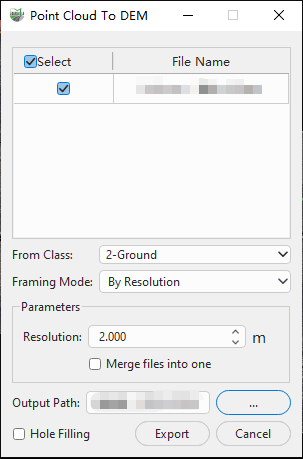
By Resolution Parameters
Parameter Description:
From Class: Select the point cloud classes used to generate the DEM. For a classified point cloud, the ground class is generally selected to prevent non-ground points from affecting the terrain elevation result.
Framing Mode: Specifies how the DEM output is organized and tiled. Two modes are available:
- By Resolution: Generates the DEM at the specified spatial resolution. In this mode, you can set the resolution and choose whether to merge multiple input point clouds into one output file.
- By Scale: Organizes and outputs the DEM according to the map sheet rules associated with the specified scale. Available scales are 1:500, 1:1000, 1:2000, and 1:5000.
Resolution(m): Sets the output DEM pixel size in meters. A smaller value produces a higher spatial resolution, while also increasing the output data volume and computational load.
Merge into One File: This parameter is available when By Resolution is selected. When checked, DEMs generated from multiple input point clouds are merged into one output file. When unchecked, separate DEM files are generated.
Note: When outputs are merged, the software processes all input point clouds together. Projects with a large coverage area or high data volume may require substantial memory. Use this option according to the computer configuration and data size.
When By Scale is selected, the dialog box displays the scale, resolution, and buffer parameters.
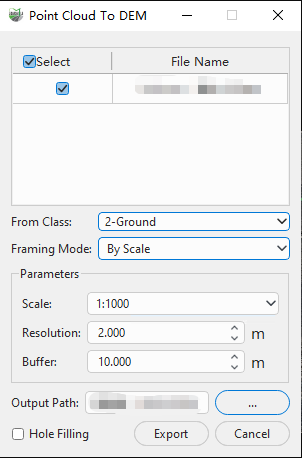
By Scale Parameters
Scale: Sets the target scale used for tiled output. Available options are 1:500, 1:1000, 1:2000, and 1:5000. This parameter is displayed only when By Scale is selected.
Buffer(m): Sets the buffer distance used for scale-based tiling, in meters. This parameter is displayed only when By Scale is selected.
Hole Filling: During the scanning process, occlusion by objects may create internal gaps in the point cloud. When this option is checked, the software automatically fills small gaps.
Output Path: The save location for the output image.
Result: The output files include the .tif image itself and the corresponding .tfw coordinate file.
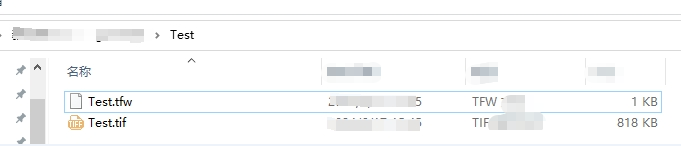
Result Files