Stand Tree Volume Analysis
Function Overview
This function calculates the standing timber volume of point clouds that have already been normalized and segmented for individual trees. Unlike Trunk Volume Computation, this function requires that the trunk points in the input data have been classified into a specific class and that the point cloud contains RGB information. The input point cloud can be the output of Trunk-Based Individual Tree Segmentation. This function attempts to locate the 3 m reflective tape (high reflectance tape placed at 1.3 m above the tree base, where the standard DBH is measured) on the point cloud for DBH fitting. The precise tree height is calculated based on the standard DBH position. The reflective tape must be placed at 1.3 m above the ground. If the tape cannot be found, the position at 1.3 m above the lowest point of the trunk is used as the reference position. For volume calculation, if the trunk is taller than 10 m, it is segmented at 2 m intervals; otherwise, it is segmented at 1 m intervals. The output includes forest stock volume, precise DBH, and precise tree height.
Usage
Click TLS Forest > Thematic Analysis > Stand Tree Volume Analysis.
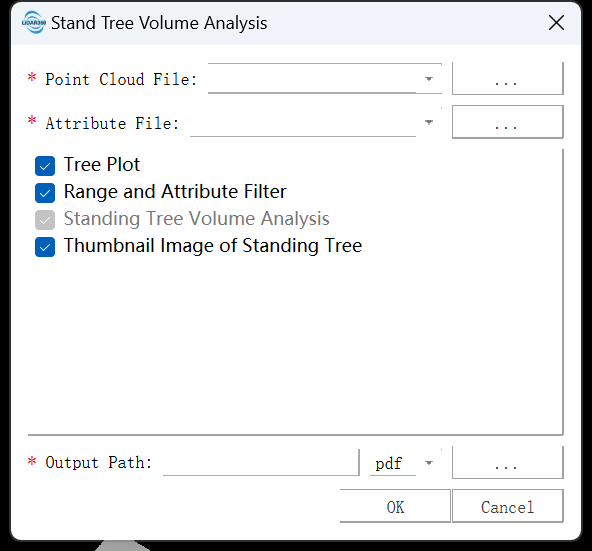
Parameter Settings
- Open Point Cloud: Select the point cloud for statistics calculation. The point cloud must have been segmented for individual trees and contain a trunk class.
- Individual Tree Attribute File: The input data is an individual tree attribute file, a comma-separated CSV table that must contain at least two fields: TreeLocationX and TreeLocationY. Refer to TLS Individual Tree Segmentation Result File Format for the specific file format.
- Trunk Class (default: "23"): The class number assigned to trunk points in the point cloud.
- Remove Unmarked Trees: If checked, trees without the 3 m reflective tape will be removed. This option cannot be checked if the input point cloud does not contain RGB information or the 3 m reflective tape.
- Treetop Length: The calculated volume result will additionally include a cone extending from the top of the trunk to the tree apex, with the base of the cone being the cross-section at the top of the trunk.