
Articles
01 Introduction to Lidar Technology
Lidar measurement technology is an emerging technology that was initially developed and put into commercial application by developed countries in Europe and America. It integrates three technologies: laser ranging system, Global Positioning System (GPS), and Inertial Navigation System (INS). It has made significant breakthroughs in the real-time acquisition of three-dimensional spatial information, providing a brand-new technical means for obtaining high spatiotemporal resolution earth space information. It is the most advanced surveying technology in the current measurement industry.
02 Advantages of Lidar Technology
(1) Rich data products
Digital Surface Model (DSM): The digital surface model accurately represents the current topography of land features and bare ground surfaces, and can be used for generating true aerial images and digital three-dimensional models.
Orthophoto (DOM): This is the image result obtained by correcting the digital aerial image pixels using the DEM, and then performing image mosaicking. It is rich in information and intuitive, with good readability and measurability. From it, natural geographical and socio-economic information can be directly extracted.
Digital Elevation Model (DEM): A digital elevation model can be generated by extracting ground data from the three-dimensional point cloud obtained through LiDAR.
Digital Line Graph (DLG): By using laser point clouds and DOM images, large-scale (1:500 to 1:2000) DLG products can be quickly produced, while reducing the workload of field mapping. The mapping efficiency is significantly improved, with an increase of 5% to 20% compared to full-field manual mapping.
(2) High degree of automation
From flight design to data acquisition, to the data processing of the final product, the degree of automation is extremely high. The flight trajectory is displayed in real time through GPS technology. There will be no missed shots and human errors will be avoided.
(3) Sensitivity of information acquisition
LiDAR can obtain target information with a resolution smaller than that of remote sensing images or radar images. It can penetrate vegetation cover to obtain ground point data.
(4) Working conditions of sensors
LiDAR measurement is an active measurement method. It emits and receives laser pulses by itself and can penetrate dense vegetation to reach the ground. It is not limited by light and shadow and can obtain a digital elevation model that is closer to the real surface morphology. It is less affected by weather and also has the wide range and high precision characteristics of aerial photogrammetry and laser ranging. LiDAR technology is the best choice for obtaining high-precision digital elevation model data in large areas.
(5) Short production cycle
The LiDAR system directly acquires the coordinates of the ground's three-dimensional point cloud and the orientation elements of the image, without or with only a very small number of ground control points, and can directly produce DEM and DOM. Compared with traditional aerial survey stereoscopic mapping, the mapping workload is 30% to 50% of it, and the mapping work is about 50% of it. This can significantly shorten the overall working cycle.
03 True-color Point Cloud Lidar System
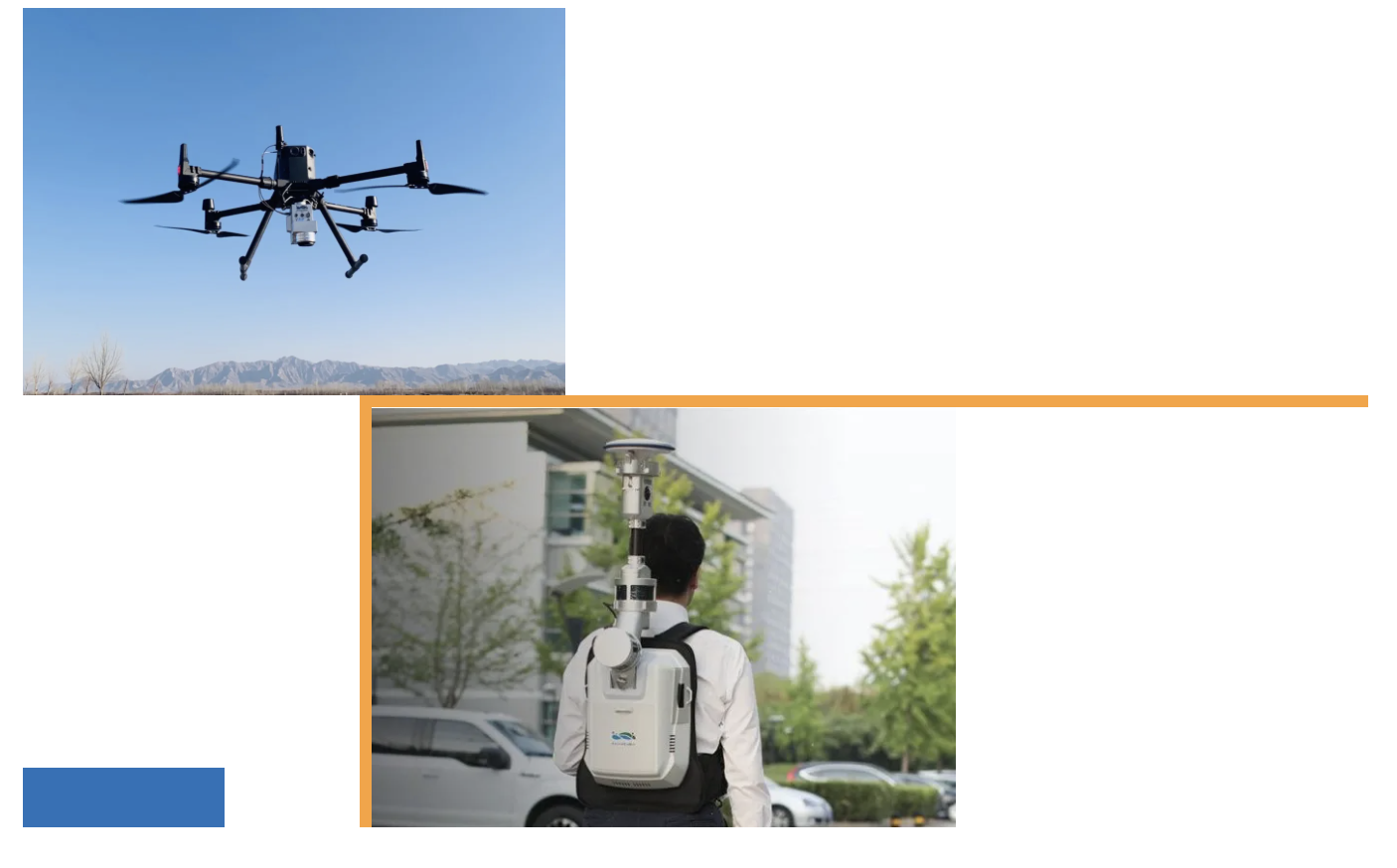
The LiAir series airborne laser radar system and the LiBackpack backpack-style laser radar system produced by GreenValley International have the ability to acquire high-density three-dimensional point clouds. The equipment uses the principle of laser echo detection to directly obtain high-density three-dimensional point clouds, and the high-density point cloud data can truly reflect the terrain and landforms. In addition, the LiAir and LiBackpack series products have the ability to acquire high-definition digital images. The professional digital cameras equipped on them can obtain high-definition digital images, which means that this system can obtain more information.
04 Application of Lidar in Engineering Surveying
(1) Rapid acquisition of digital elevation model
Laser point cloud data is the most direct data product in lidar technology. The density and accuracy of the point cloud data are relatively high, and it can clearly display the three-dimensional coordinate framework of the point positions. Through manual alternating operation or automatic running, the point clouds on targets such as plants on the ground or buildings outside the terrain will be uniformly classified, filtered or cleared. Then, a triangular network TIN will be constructed, and the DEM can be obtained promptly. Because the laser point density is very high and the number is quite large, the generation of DEM is also more convenient and accurate.
(2) Achieving Basic Surveying and Mapping
The products of basic surveying and mapping mainly include digital elevation models, as well as digital orthophoto maps (DOM), digital line maps (DLG), and digital raster maps (DRG). The generation of any of these products requires the assistance and guidance of high-precision three-dimensional information. Digital photogrammetry is quite complex to operate, and the pre-preparation of equipment and technical planning schemes are extremely strict, demanding proficient operational skills from technical staff. The data and three-dimensional coordinates obtained through laser radar technology processing can meet the needs of high-precision image differential correction, making the production of DOM increasingly simplified and no longer relying on digital photogrammetry. It can be achieved on a large scale in general remote sensing image processing systems.
(3) Applications in the Forestry Industry
Laser has a strong penetrating ability. The excellent unidirectionality of laser enables it to pass through narrow gaps and reach the surface, thereby obtaining the true elevation of the ground. It is currently the only most accurate technology capable of measuring the ground elevation in forest-covered areas. The earliest commercial application of airborne laser radar systems was in the forest industry, as the development of forestry and land management both require accurate data on forests and the terrain beneath their canopies. However, in traditional technologies, it is difficult to obtain precise information on tree height and tree density. Airborne laser radar is different from satellite imaging. When using this technology to survey the terrain beneath the tree canopy, it can also simultaneously obtain the height of the trees.
(4) Engineering Surveying
For engineering surveying, it is necessary to collect high-precision three-dimensional coordinate information of the surveying targets, and even to establish a relatively accurate three-dimensional object model. For example, in fields such as power line inspection, tunnel and mine measurement, and hydrological measurement. Ground-based and airborne LIDAR are the best methods for solving these practical problems. By superimposing the 3D models constructed based on the building models and texture information obtained from digital images, it serves as an important basis for analyzing landscapes, making planning decisions, measuring deformation, and protecting objects.
For instance, LIDAR technology provides high-precision ground elevation models DEM for road and railway design, mainly to facilitate precise calculation in aspects such as line design and construction earthwork volume. In the design of power lines, the results data from LIDAR can be used to effectively understand the terrain and geographical features within the public areas of the entire line. In areas with dense trees, the area for tree felling and the amount of timber can be estimated. During power emergency repairs and wire maintenance, the height of any point on the line above the ground can be effectively measured according to the LIDAR data points on the power line and the corresponding ground exposed points' elevations. This is very convenient for emergency repairs and maintenance to a certain extent.
(5) Implementing Urban Digitalization Construction
Currently, all industries are striving for the informatization of their own businesses. In a digital city, spatial information serves as its fundamental framework and platform, and is extremely important for the construction of a digital city. The LIDAR system can effectively obtain high-resolution and high-precision digital ground models and digital orthophotos, which can provide very valuable spatial information resources for the city and play a very important role in urban construction.
Digital cities also need to build a high-precision, true three-dimensional, measurable, and realistic urban three-dimensional model as a virtual platform for managing the city. However, for traditional technologies, creating a three-dimensional model of the city is a meticulous process with a large amount of work and very low efficiency, and the effect is not good either. This directly affects the breadth and depth of the service scope of the digital city. By using LIDAR technology to conduct aerial laser scanning of ground buildings or ground multi-angle laser scanning, high-density and high-precision three-dimensional point coordinates of the target can be quickly obtained. The point cloud data can be modeled and texture mapped with the support of software, and large-scale urban three-dimensional models can be constructed from multiple aspects. At the same time, rapid dynamic updates can be implemented, providing a solid guarantee for the continuity and historicity of the basic data sources for digital city construction.
(6) Underwater Topographic Survey
Some laser radar technologies utilize two different wavelengths of laser beams to measure the underwater terrain. Based on the current technological level, people can measure the water surface using red light (or infrared light) while using blue-green light to penetrate the water surface to measure the bottom. By calculating the time difference of receiving these two beams, the depth of the water can be determined, enabling large-scale underwater topographic surveys. Generally, the Lidar used for sea channel measurement can measure the depth of seawater up to 50 meters. Similarly, this depth varies depending on the clarity of the water quality and is widely applied in industries such as shipping routes, offshore marine areas, and hydrology.
(7) Construction of Digital Mines
The current mines and the cities dependent on them are facing significant problems. The environment has directly suffered from excessive mining, leading to environmental issues. Moreover, excessive mining is facing severe resource depletion. Additionally, the internal processes of the mines, as well as the impacts of people, machines, materials, methods, and environment, need to be considered. The current effective approach is to strengthen the construction of digital mines, viewing the problems from multiple perspectives and angles, in order to achieve a comprehensive solution.
Digital mines can use laser radar technology to quickly collect data for the entire mine and build a three-dimensional model to better represent its form. Since each part is composed differently, the emphasis considered during modeling also varies. Generally, it should be constructed layer by layer and evaluated from multiple perspectives. Usually, environmental, economic, and natural disaster aspects are evaluated. In this way, efficient feedback data can be achieved, and continuous 24-hour data provision can be provided. This is conducive to the clarity and rationality of the overall model construction. Moreover, it can predict and assess potential future accidents, helping us prevent problems before they occur.
(8) Power Transmission and Pipeline Layout
The laser radar system operating on the airborne platform is most suitable for measuring transmission lines. The aircraft can adjust its altitude and speed at any time as needed to obtain more accurate data. If video recorders, digital cameras, and other sensing devices are used simultaneously in the laser radar application platform, not only can laser radar measurements be achieved, but line inspection and mapping work can also be carried out simultaneously.
conclusion
In short, in China's engineering surveying, the application of laser radar surveying technology is extremely widespread. Compared with traditional surveying technologies, laser radar surveying technology has higher accuracy and precision, and can effectively improve the efficiency of engineering surveying. Due to the relatively late application of laser radar surveying technology in China, it is still not mature in data processing. Therefore, further research is needed to appropriately make improvements and enhancements, so as to promote the effective development of engineering surveying in China.